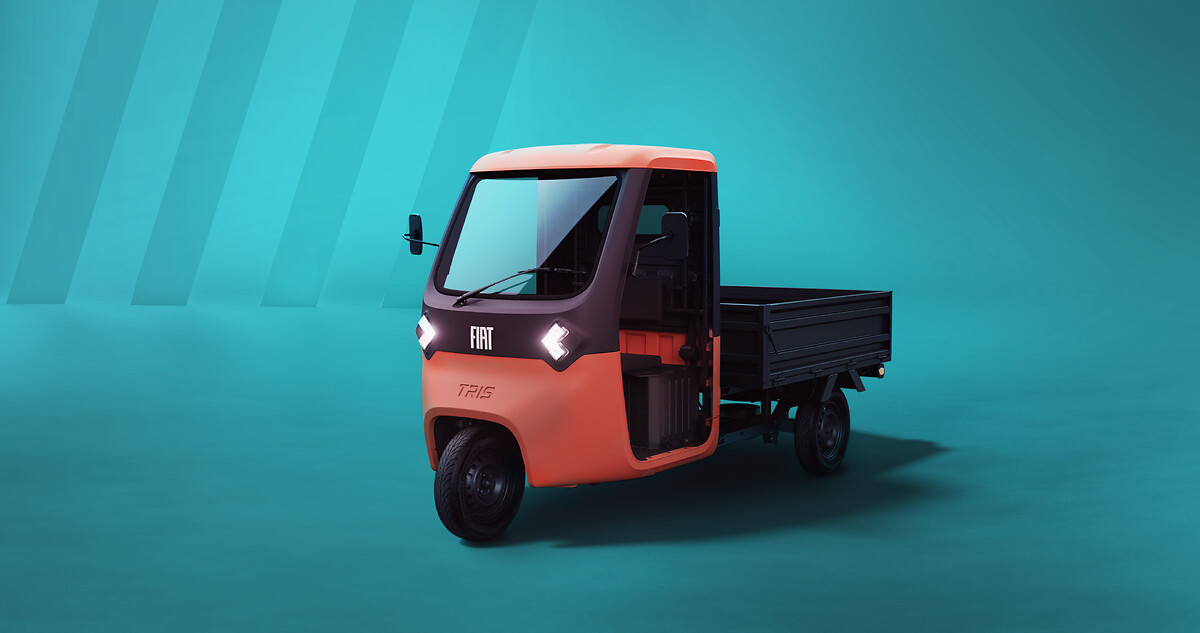
Desk-researched first look — not a road test.
For a shop, courier or tradesperson working short urban routes, the most interesting new vehicle may not be a car at all. FIAT Professional’s TRIS is a battery-electric, three-wheeled cargo vehicle aimed at last-mile work. FIAT South Africa says it is planned for South Africa and selected Sub-Saharan African markets by the end of 2026; the company has not announced a common Africa-wide retail price. FIAT South Africa’s announcement
What the TRIS actually is
Think of it as a compact work tool rather than a replacement for a van. The manufacturer quotes a 3.17-metre length and 3.05-metre turning radius, with a 48-volt motor rated at 9 kW peak and 45 Nm. Top speed is quoted at 45 km/h. Those numbers make the strongest case for dense neighbourhood delivery loops, markets and service calls—not intercity work or fast-moving arterial roads. That last point is an editorial inference from the published speed figure, not a claim of a legal restriction. Source: FIAT South Africa
The useful numbers—and the questions behind them
FIAT South Africa states that the TRIS has a 6.9 kWh lithium battery, a 90 km WMTC range, and an integrated 220V plug. It quotes 3.5 hours from 0–80% and 4 hours 40 minutes to a full charge. The same release describes payload as more than 500 kg; a FIAT Professional UK release describes about 2.25 m² of load area and space for two standard Euro pallets on the Cargo Box version. Specifications and body styles should be confirmed with the local distributor before an order, because the final African-market configuration may differ. Source: FIAT South Africa; FIAT Professional UK configuration note.
The charging claim is especially promising for a small business that can park safely near a suitable outlet overnight. It is not a reason to assume every premises is ready: an operator should have a qualified local electrician assess the outlet, earthing, load and protection, then follow the vehicle’s final local manual. Likewise, range is a test-cycle figure; route gradient, payload, heat, traffic and driving style will change the daily result.
Where it could fit across African cities
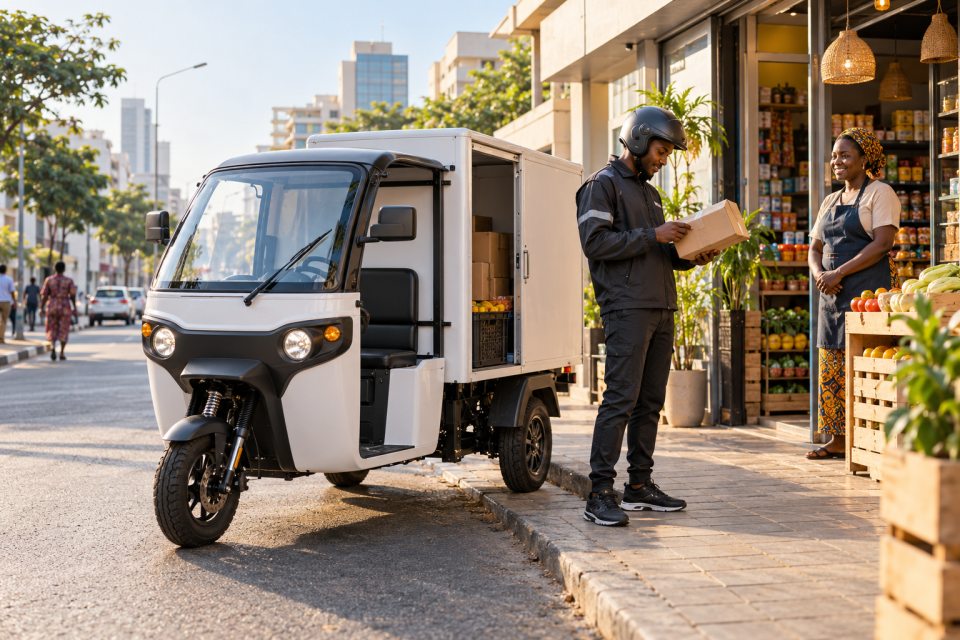
The TRIS looks most convincing where the delivery job is repeatable: groceries from a neighbourhood hub, pharmacy runs, catering supplies, parcel rounds or mobile repairs. Its compact footprint and no-clutch, no-gearbox layout could make stop-start work less tiring than a conventional small pickup. FIAT says regenerative braking is standard, which may help recapture some energy in urban use, but it does not eliminate the need to plan charging and payload carefully. Source: FIAT South Africa
What it will not settle on its own is the operating case. Businesses should ask about the battery warranty, local parts stock, service intervals, roadside assistance, registration and insurance classification, permissible roads, and the exact payload for the ordered body. Those are country- and city-specific questions; they should be answered locally before a deposit is paid.
Vroom Africa verdict
On paper, the TRIS is a thoughtful answer to a narrow but important job: short, light, urban cargo work. The 90 km claimed range and ordinary-outlet charging are attractive only if the route and depot routine fit them. For fleets, the more useful comparison may be against a motorcycle-plus-box or a small petrol pickup, using real daily kilometres, payload and downtime—not just purchase price. Treat this as a model to watch as distributors confirm markets, pricing and after-sales support.
Sources
- FIAT South Africa: TRIS reveal and Sub-Saharan Africa availability
- FIAT Professional UK: Cargo Box load-area reference
Cover image credit: FIAT Professional / Stellantis Media. In-article illustration credit: Vroom Africa / OpenAI-generated editorial illustration.